The modulation is the process to change from one key to another. In music there are three types of modulations: Diatonic, enharmonic and chromatic. Now we are going to explain the diatonic and enharmonic modulation.
First of all we are going to explain how the diatonic modulation works and will show some examples.
The diatonic modulation consist in change from a key to another using a pivot chord, that chord is common in both tonalities and is used to change in a smooth way from one tonality to another. In this case the tonalities use to be a close or relative key.
Here you have two examples of diatonic modulation, the first one in the opening of Chopin’s Prelude in C minor Op. 28, No. 20 using as a pivot chord the Ab chord, VI in C and I in Ab. The second one is in the opening of Mozart’s Sonata in D Major K. 284, using B Major, VI in D and II in A, as a pivot chord to go form D Major to A major.


The second type is enharmonic modulation, it consist in use the same chord but spelled in a different way, so that chord can be used in 4 different keys, it sounds always the same but with different notes.
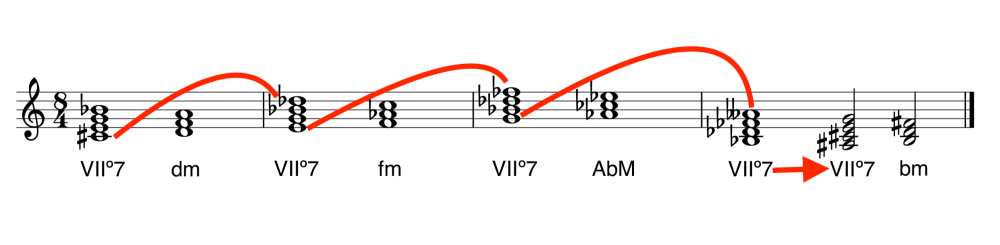
Here you have an example of the same chord that is always the VII degree and that always resolve in a different tonality. The last chord change to go to a more logical or normal tonality.

Another example that we have been working on is the modulation in the 2nd movement of Beethoven 5th Symphony. It goes from a Ab7 chord, that should resolve in a Db chord, to the ‘same chord’ F#ºº7/Ab that goes to a C chord with a G in the base.
 Ovidi Martí Garasa