In this text, I’m going to talk about a special fragment on this first movement of Antonín Dvorák Cello Concerto.
Dvorak started writing this concerto on 8 of November 1884, and finished it 11 years later, 9 February 1895, finishing it during his period in New York as the Director of the National Conservatory.
Dvorak is considered the most important figure in the Czech nationalism, due to he uses a lot of aspects, specially rhythms, of the folk music of Moravia and his native Bohemia.
The concerto is made in three movements and it’s about 40 minutes long.
The firsts movement (Allegro) starts with an orchestral introduction with two themes, one of them played by the clarinets (B.1-55) and the other one by a horn solo (B.56-86) that is expanded by the orchestra, after that the cello presentation starts playing both themes. The development (B.224-266) follows the typical sonata form. The reexposition starts in bar 267 until the end of these movement.
In this first movement we can listen a lot tension going on at the same time in the orchestra and the soloist, it’s plenty of passages with that tension, but im going to choose one that starts in the minute 10 and 45 seconds or bar 240.
Here the flutes and the oboe have the melody, and the cello is doing a kind of accompaniment but as the same time as the music is going on the tempo is increasing, also the dynamic changes from Piano to Fortissimo, and the cello becomes the leading voice, ending it with a kind of virtuosic cadenza and with a chromatic scale that develops in a theme that it’s played first by all the wood winds and then the cello responds with the same theme.
But, what creates this tension?
One important point to make the music interesting and create tension it’s the harmony.
We are in the development, and this is the most inestable part of this first movement. There are a lot of accidental sharps, and some times it modulates like in bar 240, the melody it’s in G# Major, a few bars later, in bar 250, we move to the original tonality, B minor, and that half tone between C# and D natural plus the crescendo means something special for me, and a few bars later that half tone becomes in a tone between E and F# creating even more tension than before.


Then while the cello is doing that sixteen notes on bar 261 the bassoon, oboe and clarinet are doing a ascending progression with a lot of chromaticism that help to go to the climax.
Other characteristics that create the tension are the dynamics, the beginning of this animato has to be played really soft (dolce ed animato) and try to go increasing the volume step by step, but in bar 247 we can listen a crescendo that immediately returns to piano, (that’s a nice effect) creating an interesting feeling, and there, in bar 248 is where really starts the big crescendo that ends up in the climax a few bars later.
The accompaniment in the orchestra also says something about that tension that we are talking about, the beginning in bar 240 we have one quaver per bit, in bar 248 we have two groups of the quavers an then in bar 261 we have a rhythm with a semiquaver and a quaver, it means that the figuration it’s increasing and at the end it’s more faster and light.
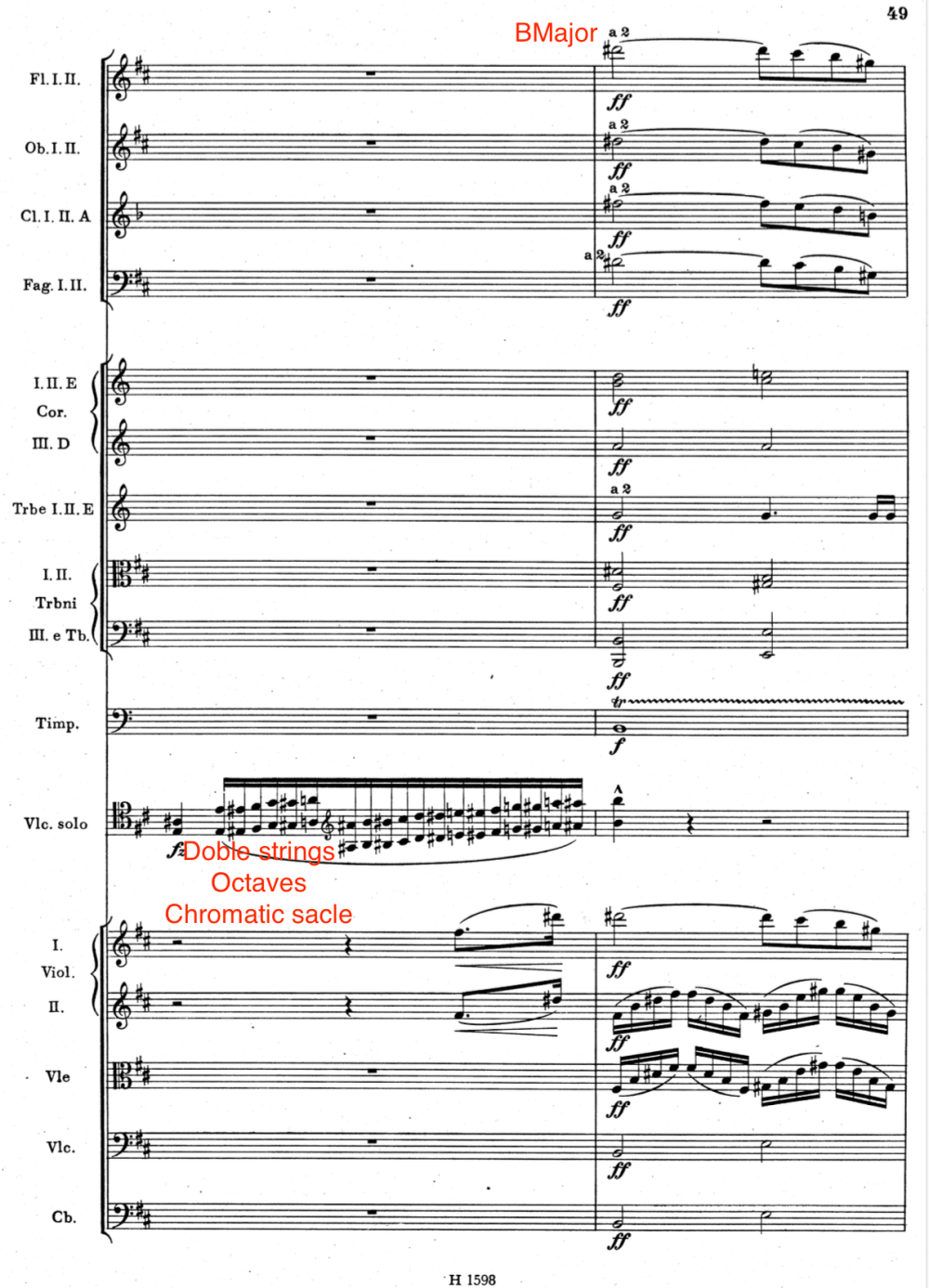
And of course the cello takes an important part helping to create the tensions, as we said the beginning is very soft,but in 248 begins the real crescendo and then the use of double strings, octaves and lots of accidental alterations ends with the chromatic scale in bar 266 played in octaves and ending in B Major, the original tonality to start the reexposition.
 Ovidi Martí Garasa